Skip to content
Choosing business packaging bags is a practical decision with visible consequences. A paper handle can tear under a heavy order. A thin mailer may split at the seal. Buyers must compare material, dimensions, load capacity, print quality, minimum order quantities, and delivery schedules—not just unit price.
The Flexible Packaging Association’s 2023 State of the Flexible Packaging Industry report estimated U.S. industry sales at $42.9 billion in 2022. That figure signals a substantial market, but it does not mean every flexible bag suits every business. Ellen MacArthur’s circular-economy work offers a useful design principle: “designing out waste and pollution, keeping products and materials in use, and regenerating natural systems.” Her foundation presents this as a framework, not a simple claim that one material is always greener. Still, no bag is perfect. A recyclable option may have limited local collection, while a reusable bag only helps when customers reuse it.
This guide compares ten wholesale-ready options, from kraft paper shopping bags to flexible mailers and reusable totes. It focuses on everyday buying details: how bags feel in hand, what they can carry, and how clearly they present a brand. Where performance depends on construction or supplier specifications, buyers should request samples and verify the details before ordering. A small test run can reveal more than a polished product photo.
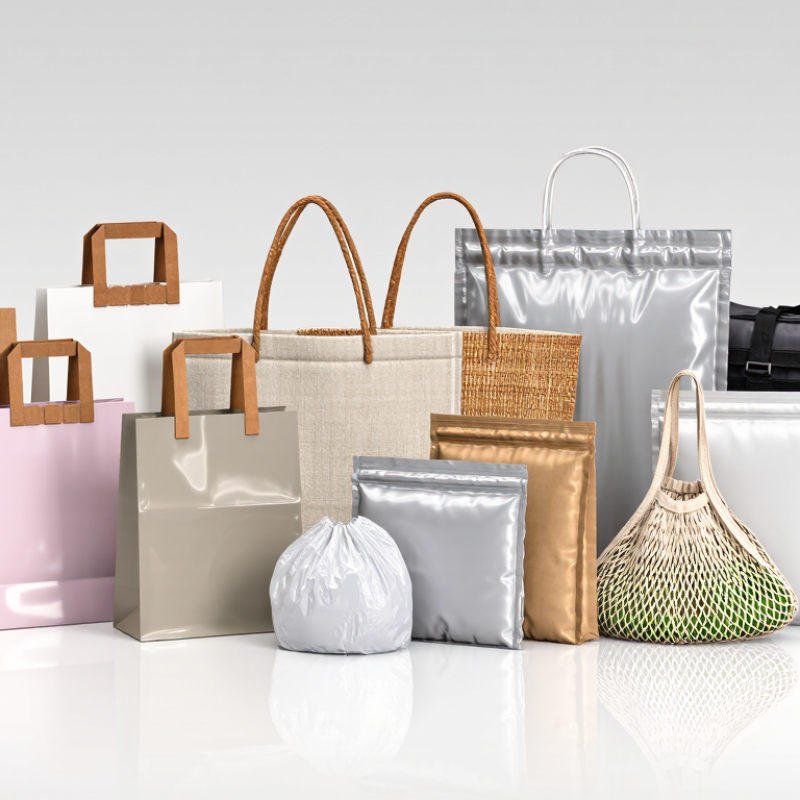
Wholesale buyers can compare five paper-based options: flat paper shopping bags, twisted-handle bags, SOS kraft sacks, gusseted kraft bags, and corrugated mailers. Flat bags suit lightweight goods; twisted handles feel sturdier in hand. SOS sacks stand open on counters, while gussets add room for boxed items. Corrugated mailers protect books and small products with less empty space. Check handle strength, paper weight, and packed dimensions before ordering. The U.S. EPA reported a 68.2% recycling rate for paper and paperboard in 2018, but local collection rules still matter.
Five more options cover varied shipping and retail needs: lightweight poly mailers, padded bubble mailers, courier bags, woven polypropylene bags, and compostable mailers. Poly mailers are light and resist moisture; padded versions cushion fragile goods. Courier bags often have a peel-and-seal closure, while woven polypropylene bags handle heavier loads and repeat use. Compostable mailers need suitable processing facilities. Not always available.
The OECD’s Global Plastics Outlook estimated that only 9% of global plastic waste was ultimately recycled in 2019. That makes disposal access worth checking, not just purchase price. Ask suppliers for sample bags, then test them with your actual products and packing routine. Fit matters. A bag that is too large can waste material; one that is too tight may split at the seams.
| Bag type | Common material | Typical business use | Practical advantages | Wholesale buying considerations | End-of-life notes |
|---|---|---|---|---|---|
| Paper shopping bags | Paper, often with twisted-paper or flat-paper handles | Retail shops, boutiques, events, and takeaway purchases | Easy to print and widely available in different sizes and paper weights. | Check handle attachment, base construction, paper weight, and the expected load. | Uncoated paper may be recyclable where paper-bag collection is accepted; food or liquid contamination can affect acceptance. |
| Kraft paper bags | Brown or bleached kraft paper, with or without handles | Retail packaging, bakeries, cafés, and general-purpose packing | Available in many formats and can be supplied plain or printed. | Confirm bag dimensions, paper weight, handle style, and whether a moisture barrier is needed. | Uncoated kraft paper is commonly recyclable where local paper recycling rules allow it. |
| Self-opening kraft sacks | One or more plies of kraft paper, usually with a flat bottom | Grocery, food-service, and counter-service businesses | Designed to stand open for filling and can be ordered in several capacities. | Match sack size and paper strength to the product; verify food-contact suitability when required. | Clean, uncoated paper may be recyclable; recycling options vary by location and contamination. |
| Laminated paper bags | Paper with a plastic film or other laminated surface | Retail packaging where a smoother finish or added surface protection is desired | Supports printed finishes and can offer more resistance to scuffs or light moisture than plain paper. | Ask which layers are used, how the handles are attached, and whether the construction suits the intended load. | Mixed-material construction can make recycling more difficult; check local guidance and supplier specifications. |
| Poly mailers | Flexible polyethylene film, commonly made from LDPE or related polyethylene materials | Shipping apparel, soft goods, and other non-fragile products | Lightweight, flexible, and typically equipped with a sealable flap. | Compare dimensions, film thickness, seal strength, opacity, and compatibility with shipping labels. | Store drop-off or curbside acceptance depends on local programs and the specific film; do not assume curbside recyclability. |
| Recycled-content poly mailers | Polyethylene film containing recycled material; content levels vary by specification | E-commerce shipping for soft, non-fragile goods | Can incorporate post-consumer or post-industrial recycled content while retaining a flexible mailer format. | Request documentation for recycled-content claims and test sealing and tear performance with actual shipments. | Recycling options generally follow local rules for flexible plastic film; verify acceptance before making disposal claims. |
| Paper mailing bags | Kraft or other paper, sometimes with a reinforced construction or closure strip | Shipping documents, books, and some lightweight goods that do not need cushioning | Offers a paper-based outer format and can be easy to label and handle. | Check closure design, paper strength, size, and protection needs for the contents and shipping route. | Paper-only versions may be recyclable where accepted; remove or separate non-paper components if local rules require it. |
| Padded mailers | Paper or plastic outer layer with a cushioning layer, such as paper padding or bubble material | Mailing small items that need more protection than a flat envelope provides | Provides cushioning in a compact shipping format; protection depends on the mailer construction and contents. | Review internal dimensions, padding type, closure strength, and whether the item needs a separate protective wrap. | Recycling depends on the materials and whether layers can be separated; check the product specification and local rules. |
| Woven polypropylene sacks | Woven polypropylene (PP) strips, sometimes with a liner or coating | Bulk agricultural, industrial, and construction materials | Woven construction provides a durable format for many bulk-packaging applications. | Specify dimensions, fabric weight, seam construction, safe working load, and any liner or coating requirements. | Recycling availability varies; liners, coatings, and product residue may affect acceptance. |
| Reusable nonwoven PP bags | Nonwoven polypropylene fabric, commonly made from bonded PP fibers | Retail shopping, events, and repeated-use promotional or utility bags | Lightweight and available with different handle and gusset configurations. | Compare fabric weight, stitching or bonding, handle reinforcement, dimensions, and intended reuse conditions. | Recycling access varies by location and material collection program; confirm local options rather than assuming curbside acceptance. |